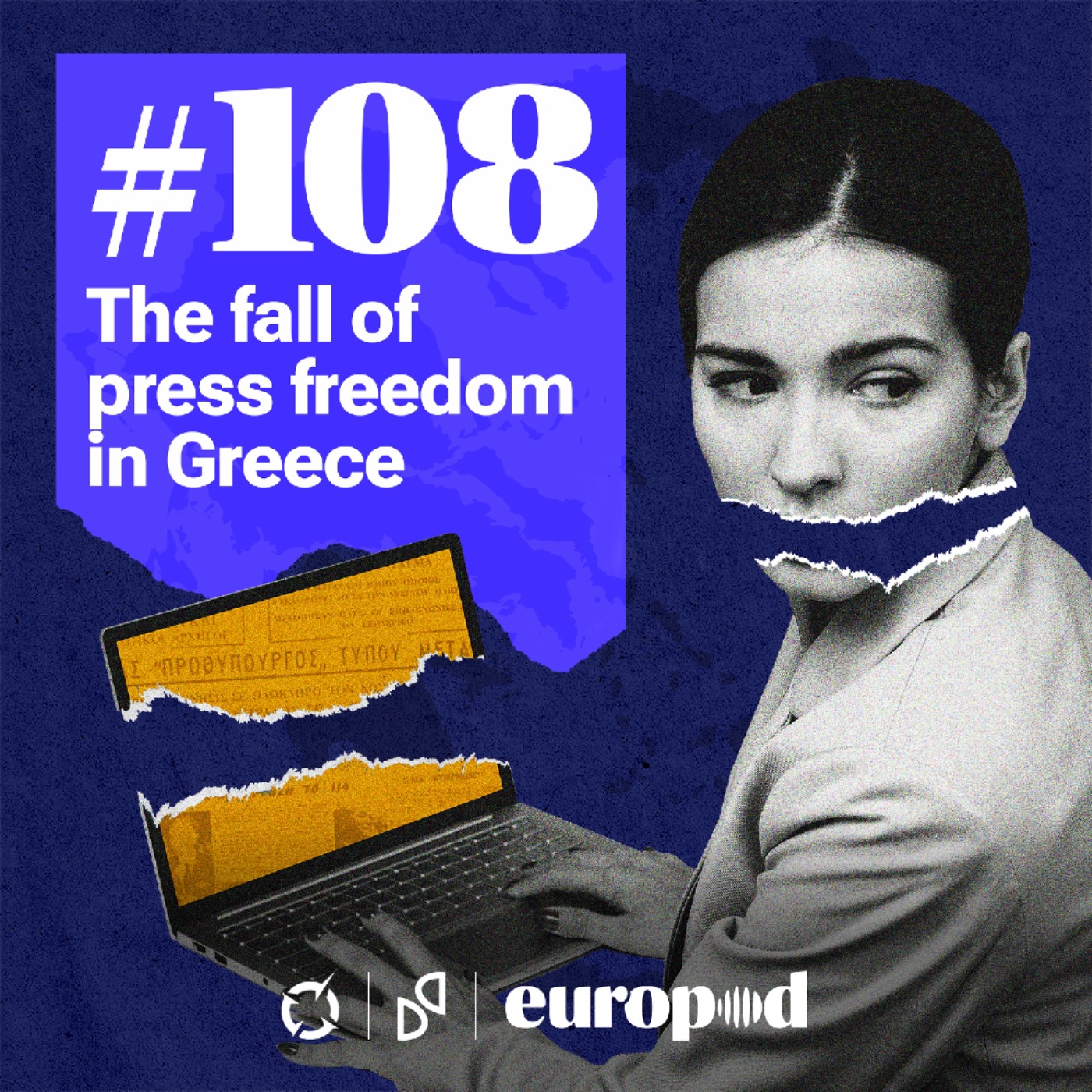
#108 the fall of press freedom in greece by Europod
Thirty-eight places worse than in 2021 and last in the ranking of EU countries, press freedom in Greece is undoubtedly in free fall. According to the annual report of Reporters Sans Frontières (RSF), in a total of 180 countries, the country referred to internationally as the matrix of democracy has plummeted in just one year from 70th to 108th place in 2022.
In the following six episodes, Greek journalists Konstantinos Poulis and Jenny Tsiropoulou will take us inside newsrooms to see the working conditions in the media, investigate the unsolved murder of a journalist at the door of his house, talk to journalists-victims of SLAPPS and journalists-victims of phone tapping, and they will talk to us about a completely opaque process of public funding to find out what the 108th place means in practice and to ask who benefits from journalism that is feared and silenced.
We would like you to know that the present government has systematically failed to respond to requ
Very recently, Greece learned the meaning of the term SLAPP, short for Strategic Lawsuit Against Public Participation. It was not because Greeks read it in a book but because several journalists have been targeted by companies with lawsuits because of their investigative reporting and are thus called upon to face powerful giants in courtrooms. As explained during the last episode, this practice happens not with the aim of financial compensation for defamation but all for legal bullying and the gagging of the journalist.
In the context of COVID-19 and its very special circumstances, the Greek government decided to give a huge amount of money, around 20 million euros, to friendly media to promote the messages of Civil Protection to deal with the pandemic. The media outlets that received the money were gathered in the so-called Petsas’ list, named after the respective minister’s last name. The press critical of the government received less than 1% of the total amount. To this day, there has been no official response answering the question of what criteria were used to award the money.
News manipulation and censorship have been done in many indirect ways, mainly economically. But sometimes, it is crude and overt in Greece: journalists cannot publish what they want, or they might lose their jobs. Even if they wanted to take the risk, the content never reaches the recipient because it is cut off by the editorial staff.
Of all the things that prevent a journalist from doing his job, there is only one invincible obstacle. Murder. In Greece, a journalist who covered crime news, George Karaiwaz, was killed. A delayed government response followed the murder, and even today, the process of solving the murder seems slow to non-existing. For the third episode, we talked among others to the widow of the murdered journalist, experienced crime reporters, and Pavol Szalai from RSF to understand the context in which the Karaiwaz was killed.
Greece is back on the front page of the international media after a significant phone-tapping scandal. The wiretaps were carried out against the journalist investigating financial scandals, Thanasis Koukakis, and the political leader of the third largest political party, Nikos Androulakis. A short time earlier, another journalist who specialized in the refugee issue, Stavros Malichoudis, had discovered that he was being monitored by the National Intelligence Service (NIS) as an enemy of the state. The Predator malware was used for the surveillance. As a consequence of the revelations, the general secretary and nephew of the prime minister, Grigoris Dimitriadis, and the commander of the NIS, Panagiotis Kontoleon, resigned.
From 2022, Greece ranks the worst of all EU countries in the RSF ranking for press freedom. Why has it fallen from 70th to 108th out of 180 countries? What is happening to the media in the so-called birthplace of democracy? The first episode of the podcast series offers an informative retrospective for both international and Greek audiences, setting the context for a better understanding of the following episodes. Therefore, it is a short walk through all the issues that were the criteria for downgrading Greece's position: surveillance, the murder of a journalist, SLAPPS, self-censorship and censorship, and economic manipulation.
